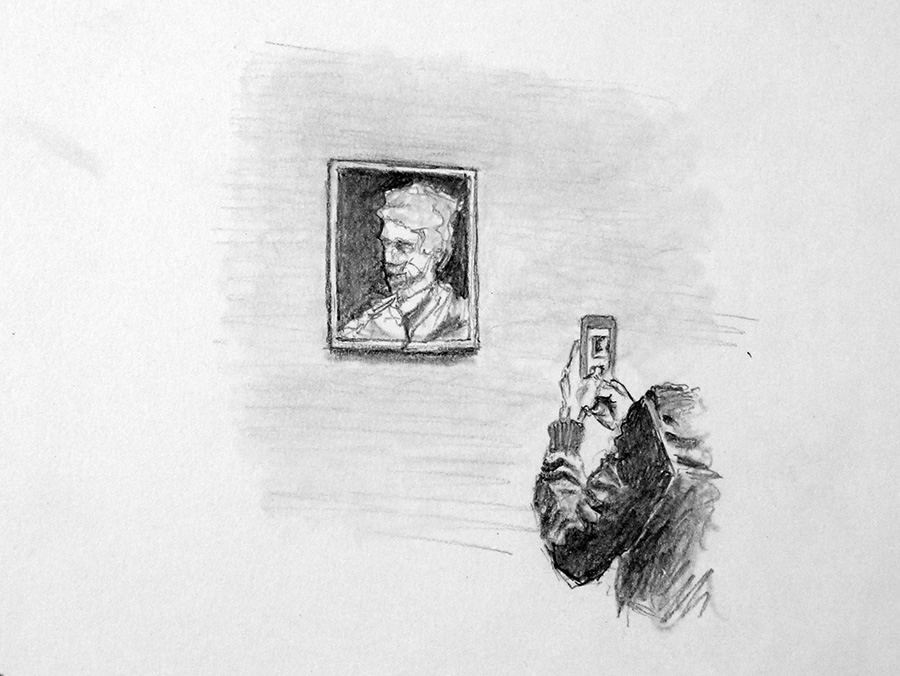
At the Met: the cellphone brandished as a weapon, a screen, an interpreter-par-excellence, of all art. I observe the same ritual time and time again: a museum-goer approaches a work of art – usually a famous one – stops several feet away, holds up her phone at arm’s length, takes a picture, turns and marches off to the next piece. Another spectator fills her place, similarly armed. Here the camera has become more than an extension of the eye or a handy mnemonic device; it has literally become a replacement for the eye and the mind. The phone’s camera does what the spectator’s eye would normally do, registering the image, a ‘representation’ of the work; then the phone’s memory does what the mind would normally do in storing this image away for future reflection. Only, one has to ask: does this future reflection ever take place? And if so, when? Hours later? At home? At work? In moments of down time or boredom? Doubtful. Why then bother going to a museum at all? The act of looking at a work of art has been reduced to an act of mechanical registration, and in the process, turned the museum into a shooting gallery. Is this simply one more example of the quintessential tourist snapshot? An indexical ‘proof’ that someone has been there, done that? But proof for whom?

 People in Public
Leave a comment