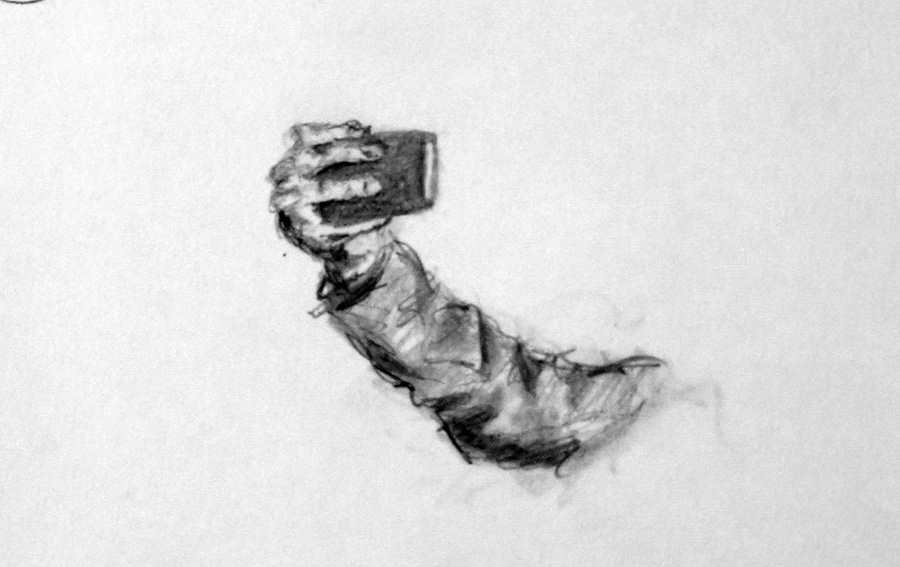
I watch a man strolling through Prospect Park having a conversation on FaceTime. He moves as if he’s entirely immersed in his own world – which is to say, the world of the phone – and yet he swerves to avoid a couple with a stroller at the very last second, pivoting gracefully as he reaches an intersection in the sidewalk. He’s clearly well-adapted to this exercise. But what kind of exercise is this? Increasingly common in public spaces, this blend of movement and communication is a highly specific, carefully-choreographed dance, a delicate balance of various, competing foci. One must carry on a conversation with one’s interlocutor – which means maintaining visual contact with the device itself, upon which the other person’s image appears – while at the same time navigating complex physical spaces. One must thus split one’s attention between the real and the virtual, between busy sidewalks and a tiny digital screen, a bifurcation that applies not just to the focus of attention, but to one’s self-presentation, and hence, self-consciousness: how do I look as I’m walking down the street holding this device at arm’s length, chatting away, and how do I look to the person on the screen with whom I’m talking? Also: the camera and screen are united in the device, so one is simultaneously viewing and filming. What kinds of cinematographic decisions are being made as the device is held in a certain way, capturing the face from a low angle for example, or held off to one side (the speaker’s ‘good side’)?

 People in Public
Leave a comment